2026-05-29
Gangnam Urology: Could Male Hematuria Be a Sign of Bladder Cancer?
Hematuria (blood in urine) can be a sign of serious conditions like bladder cancer. Learn about the causes, diagnostic tests, and the benefits of flexible cystoscopy at Hanaro Medical Foundation.

Gangnam Urology: Could Male Hematuria Be a Sign of Bladder Cancer?

Hello. This is Hanaro Medical Foundation, your Gangnam Urology Health Checkup Center.
Hematuria, the presence of blood in the urine, can be a temporary symptom or a signal of a serious health issue. Because the causes are diverse, if you suspect hematuria, you must receive a consultation and examination at a Gangnam urology clinic.
Today, Hanaro Medical Foundation will explore the ‘causes of hematuria and diagnostic methods’.
Types of Hematuria
Hematuria is a phenomenon where red blood cells are mixed into the urine, indicating bleeding somewhere in the urinary tract.
✔️ Gross Hematuria: The color of the urine is visibly changed to the naked eye.
✔️ Microscopic Hematuria: Can only be confirmed under a microscope.
Hematuria requires careful attention as it can be a warning sign of urological abnormalities such as kidney cancer or bladder cancer.
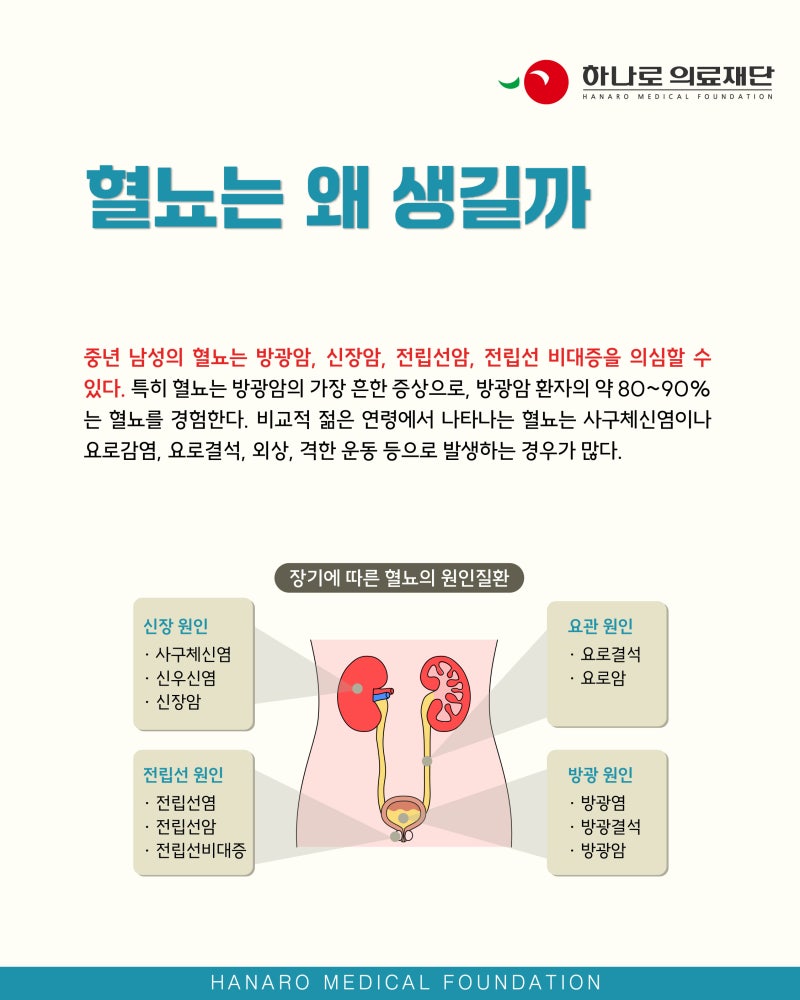
Causes of Hematuria
In middle-aged men, hematuria may suggest bladder cancer, kidney cancer, prostate cancer, or benign prostatic hyperplasia (BPH). In particular, hematuria is the most common symptom of bladder cancer, experienced by approximately 80–90% of bladder cancer patients. Hematuria appearing in relatively younger ages is often caused by glomerulonephritis*, urinary tract infections, urinary stones, trauma, or intense exercise. In other words, since hematuria can be a symptom of bladder cancer, you must consult with a Gangnam urology specialist.
*A group of diseases where the glomeruli in the kidneys become inflamed and damaged.
Kidney Causes | Ureter Causes | Prostate Causes | Bladder Causes |
· Glomerulonephritis · Pyelonephritis · Kidney Cancer | · Urinary Stones · Ureteral Cancer | · Prostatitis · Prostate Cancer · Benign Prostatic Hyperplasia | · Cystitis · Bladder Stones · Bladder Cancer |

Hematuria Testing
If hematuria is suspected, the process begins with a urinalysis, followed by blood tests, kidney ultrasound, abdominal CT, or cystoscopy as needed. Specifically, if gross hematuria appears in men over 50 with a history of smoking, bladder cancer should be suspected, and the most critical examination at this stage is a cystoscopy.
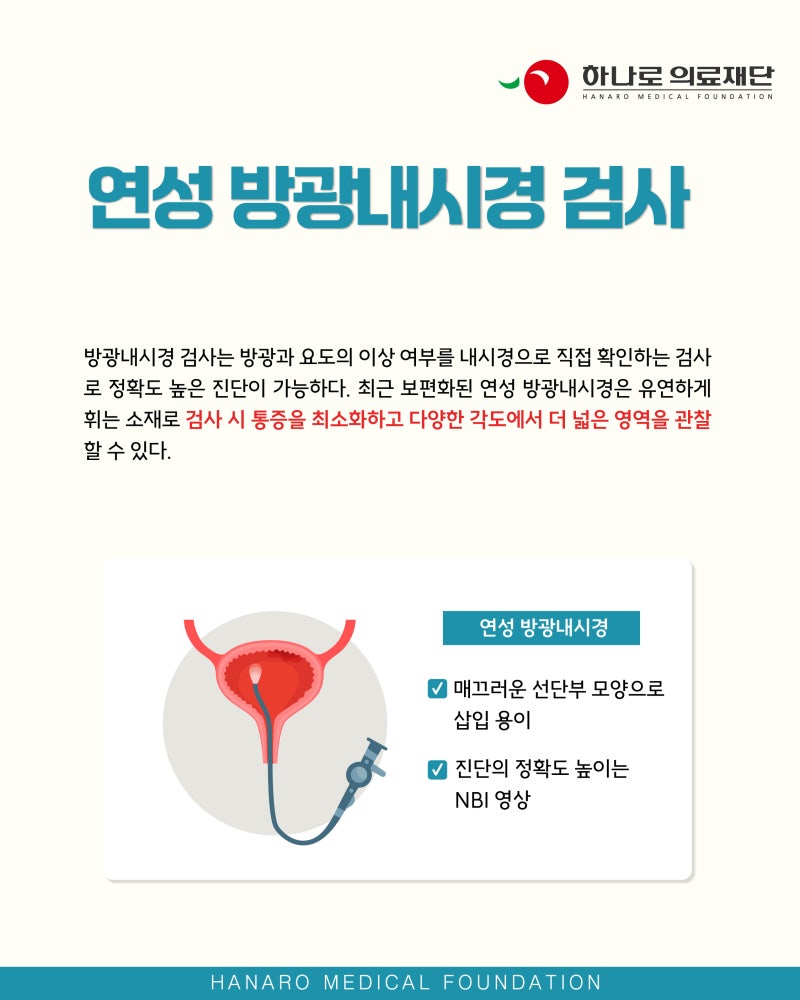
Flexible Cystoscopy
A cystoscopy is an examination that allows for a highly accurate diagnosis by directly checking for abnormalities in the bladder and urethra using an endoscope. The recently popularized flexible cystoscopy uses a flexible material to minimize pain during the procedure and allows for observation of a wider area from various angles.
✅ Easy insertion due to the smooth tip shape
✅ NBI imaging that enhances diagnostic accuracy

When You Must Visit a Urology Clinic
– When you frequently feel discomfort while urinating
– When there is no pain, but the condition of the urine appears poor
– When you experience hematuria
– When you feel any other abnormal symptoms in the genitourinary system

At Hanaro Medical Foundation (Gangnam),
We have invited Professor Byung Ha Chung, who served as the former Head of Urology and Team Leader of the Prostate Cancer Clinic at Gangnam Severance Hospital.
He focuses on treating urological diseases such as prostate cancer, benign prostatic hyperplasia, bladder cancer, and kidney cancer. We invite patients concerned about these conditions to seek his expertise.
You can book an appointment with Director Byung Ha Chung of the Urology Center more quickly and easily through Naver Reservation.

#Hematuria #BladderCancer #FlexibleCystoscopy #HanaroMedicalFoundation #HanaroMedicalFoundationGangnamCenter #HanaroLeadersClinic







Frequently Asked Questions
Does hematuria always mean bladder cancer?
No, it does not. Hematuria can be caused by various reasons other than bladder cancer, such as kidney cancer, prostate cancer, benign prostatic hyperplasia, urinary stones, and urinary tract infections. However, since approximately 80-90% of bladder cancer patients experience hematuria, if you have symptoms, you should definitely seek an accurate diagnosis from a urology specialist.
Can hematuria appear in younger age groups?
Yes, it can. In relatively younger age groups, hematuria often occurs due to glomerulonephritis, urinary tract infections, urinary stones, trauma, or strenuous exercise. Regardless of age, if hematuria is observed, we recommend tests to determine the cause.
What tests will I undergo if hematuria is suspected?
We will start with a basic urine test. Subsequently, depending on the patient's condition and necessity, additional tests such as blood tests, kidney ultrasound, abdominal CT, and cystoscopy will be performed to identify the exact location and cause of the bleeding.
Is cystoscopy very painful?
Recently, flexible cystoscopes, which significantly reduce pain, are mainly used. They are made of a flexible material to minimize pain during the examination, and their smooth tip shape makes insertion easy, reducing patient discomfort.
What should men over 50 do if they have gross hematuria?
You should immediately visit a urology department and undergo a cystoscopy. Especially for men over 50 with a history of smoking, the risk of bladder cancer is high, so directly checking for abnormalities in the bladder and urethra through endoscopy is crucial.